When it comes to the Chinese language, there are two major types that are commonly spoken. These are Mandarin and Cantonese. Both these languages have their own unique features, in this blog post, we will be exploring the key differences between them.
Mandarin is the national language spoken by billions of people in Mainland China and Taiwan, while Cantonese prevails in Hong Kong. Macau, as well as Guangdong speak this variety to some extent too!
The two languages share a lot of similarities. Though they're quite similar, there are still some key differences between them. Let's take a closer look.
Cantonese vs Mandarin Tones
MANDARIN TONES
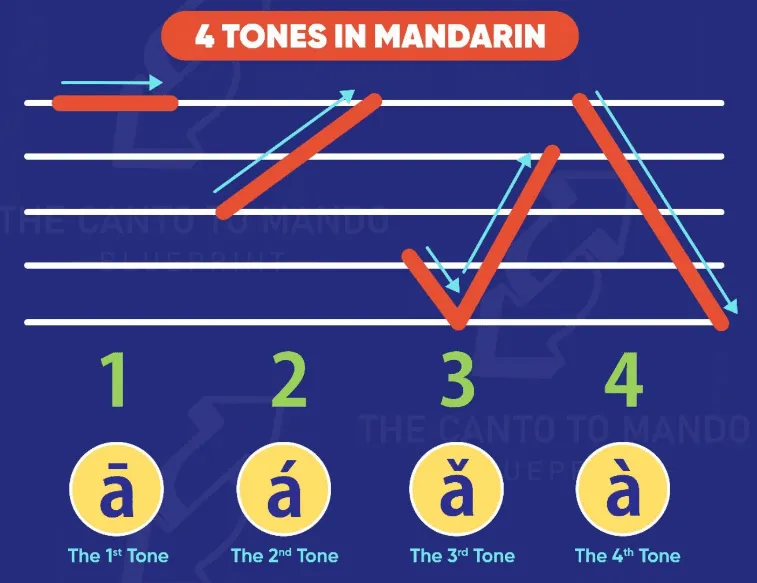
For example, the Chinese word "ma" can mean mother, hemp, horse, or scold, depending on the tone. This can make learning Mandarin a challenge for English speakers, who are used to using inflection to change the meaning of words. However, tones can also be a useful tool for adding nuance and expression to speech.
For instance, a question asked in a rising tone is more likely to sound polite than one spoken in a falling tone. As such, tones are an important part of the Mandarin language and can help to add depth and meaning to communication.
As any linguist knows, tones are an essential part of spoken language. They can be used to convey meaning, emphasize certain words, or express emotions.
CANTONESE TONES
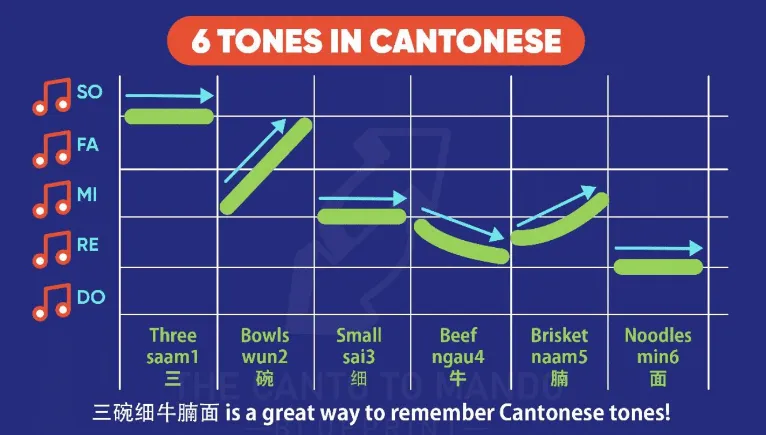
The language of Hong Kong and Macau, Cantonese, is a tonal tongue with six different tones. Each syllable can be pronounced in one or more ways depending on its individual tone - this makes it difficult for non-native speakers to pronounce some sounds!
For example, the word ma can have six different meanings depending on the tone it is pronounced with. This can make Cantonese a challenging language to learn, but it also makes it immensely expressive.
When used skillfully, the different tones of Cantonese can add a wealth of meaning to a simple sentence. They can also be used to create playful word games and puns. As a result, Cantonese is a rich and fascinating language that is well worth learning.
Cantonese vs Mandarin Pronunciation
In addition to the different tones, there are also some differences in the way that certain words are pronounced in Mandarin and Cantonese. This is due to the fact that Mandarin is based on the Beijing dialect while Cantonese is based on the Guangzhou dialect.
As a result, the pronunciation differs. Let's look at this word below.
想 (to want)
For this word above, the Mandarin word for 'to want' is 'xiang3' while the Cantonese word for 'to want' is 'soeng2'. Notice how the pronunciation is completely different.
Once again however, if you speak even one of these languages, learning the other becomes SIGNIFICANTLY easier. This is due to Pinyin and Jyutping Mappings between the two languages (a fancy way of saying word mappings).
More details in the video below:
Cantonese vs Mandarin Grammar / Writing System
Another difference is in grammar and writing system. While both languages use the Chinese characters as an "alphabet", there are variations in the way they're used.
There are instances when they are the same. Let's look at the example below:
我想出去 (I want to go out)
However, there are times when they differ. Let's look at the sentences below.
Mando: 我想【吃】饭 (I want to eat)
Canto: 我想【食】饭 (I want to eat)
Luckily, if you speak Cantonese, then learning Mandarin is A LOT easier , as there are rules that help you bring your Cantonese over to Mandarin. Even if you speak only a liiitle bit of Cantonese, learning Mandarin becomes a lot easier once you know these rules. Examples can be seen in the video below:
Conclusion
The differences between Mandarin and Cantonese are significant, with the two languages having many similarities at first glance but also some notable dissimilarities.
From pronunciation and grammar to writing systems and vocabulary, these two languages differ in many ways. Nevertheless, they do share some similarities such as the use of standard Chinese grammar rules. As a result, it can be quite difficult for those who are not familiar with both of these languages to tell them apart.
The Canto to Mando Blueprint that we've created is the most comprehensive Mandarin learning system designed specifically for Cantonese speakers of any level . You can get started with a free beginner lesson and receive a free $100 value DirectTranslation™ Guide when you sign up today. With this effective method, you will be able to speak conversational Mandarin in 6 weeks. So don't wait any longer, sign up for your free lesson today!