Can Cantonese Speakers understand Mandarin right off the bat?
The answer is NO.
BUT If you're a Cantonese speaker looking to learn another Chinese dialect, Mandarin is the way to go. Cantonese is spoken by over 80 million people worldwide and is one of the five major dialects of Chinese. 72 million may sound like a lot, but that is NOTHING compared to the 1.1 BILLION Mandarin speakers.
Many Cantonese speakers find that Mandarin is easier to learn than their native dialect, and there are a few reasons for this. Here are three reasons why Mandarin is the easiest language to learn for Cantonese speakers.
1. Mandarin and Cantonese have almost IDENTICAL Grammar Structures
Mandarin and Cantonese are both members of the Chinese family of languages. As such, they share almost identical grammar structures (more details here) .
What this means is that any Cantonese speaker can form a large amount of Mandarin sentences from DAY ONE. All that Cantonese Speaker needs to learn is the new Mandarin pronunciation. Refer to the video below for some examples of similar sentence structures between Cantonese and Mandarin.
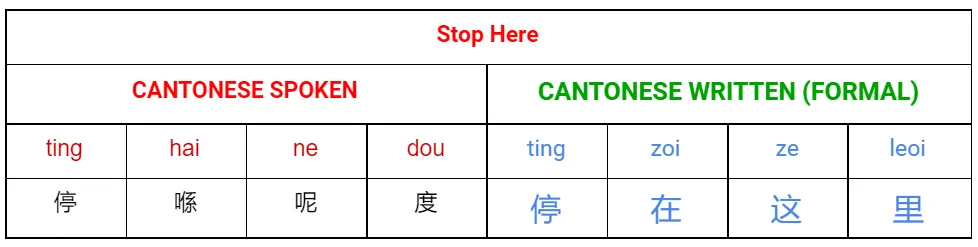
2. Mandarin is ESSENTIALLY Formal Cantonese
Whenever Cantonese speakers hear formal Cantonese, what they are hearing most of the time is actually Mandarin. The best way to illustrate this is with this graphic below:
We expand a bit more on this in this article on how to improve your Cantonese ! But essentially, conversational Cantonese is extremely different from the written form of Chinese you see on newspapers. Written Chinese sentence structure often employs the Formal Cantonese Written structure as opposed to daily conversational Cantonese sentence structure. Coincidentally, this formal Cantonese written structure happens to be EXACTLY the same as daily Mandarin structure.
What this means is that by learning Mandarin, learners will improve in both Cantonese AND Mandarin at the same time. Furthermore, as the learner learns more Cantonese in the formal context, their Mandarin will also improve too! This leads us to ask this next question below:
Are Mandarin and Cantonese Mutually Intelligible?
Mandarin and Cantonese are two varieties of Chinese that are often spoken about in the same breath. There is a long-standing perception that the two are mutually intelligible, meaning that speakers of one language can understand speakers of the other. However, research has shown that this is not the case. Watch the video below to see how difficult it can be for a Mandarin speaker to try and understand Cantonese!
In fact, there are a number of significant differences between Mandarin and Cantonese that make them difficult for speakers of one to understand speakers of the other.
The most important difference between Mandarin and Cantonese is their respective phonologies, or sound systems. Although both varieties use largely the same set of consonants and vowels, they differ in how these sounds are combined to form syllables. Listen to the sounds in the video below to hear how they differ!
In addition to their different phonologies, Mandarin and Cantonese also have different lexicons, or vocabularies. Although both varieties share a core vocabulary, they also have words that are unique to each variety. This is due to the two varieties have developed independently from each other over the centuries. As a result, Mandarin speakers may not be familiar with certain Cantonese words, and vice versa.
Finally, another difference between Mandarin and Cantonese is their writing systems. While both varieties use Chinese characters as their written language, they differ in how these characters are pronounced.
With that being said, ,any people believe that learning Mandarin is difficult. However, as a Cantonese speaker, I have found that it is actually quite easy to learn. While they are not mutually intelligble, they share SO many similarities.
In fact, if you know how to leverage your Cantonese to help you learn Mandarin, it becomes extremely easy! The problem is most Mandarin learning resources are designed for people with NO Cantonese background. But for those of us who speak even a liiitle bit of Cantonese, we can start by learning about Cantonese vs Mandarin tone mappings! This helps you learn Mandarin tones from a Cantonese perspective!
For many people, the idea of learning a new language can be daunting. However, with the plethora of resources available today, there's no reason to feel overwhelmed. In fact, you may be shocked at how easy it is to get started learning Chinese using Cantonese.